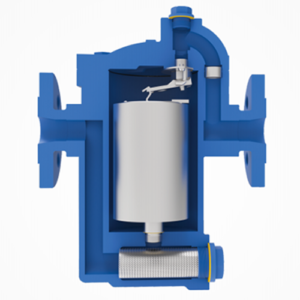
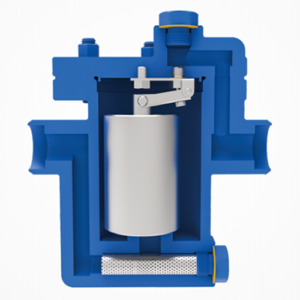
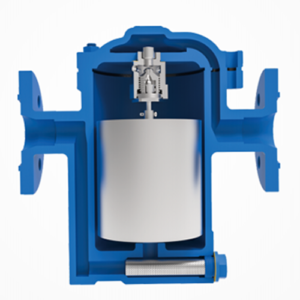
Among the working principles of various steam traps, the inverted bucket type is the most reliable. The core of its design is a unique lever system that amplifies the force provided by the float to overcome the steam pressure to open the valve. Since the float opening is inverted, it can prevent damage caused by water hammer. In order to extend its service life, each wear point has reinforcement measures.
The inverted bucket type steam trap has only two moving parts: the valve lever suspension and the inverted bucket, and it will not get stuck or blocked.
| • Wear and corrosion resistant | • Continuous exhaust of air and carbon dioxide | • Cleansing effect | • No more trouble with dirt | • Works well under back pressure |
| The free-floating guided lever mechanism is frictionless, all wear points are reinforced, all moving parts are stainless steel, valves and seats are also stainless steel or alloy. They are ground separately and matched together on the machine. | The vent hole on the top of the inverted barrel can continuously and automatically discharge air and carbon dioxide without forming cold lag or air lock. A small amount of steam passes through the vent hole to make up for the heat loss of the valve body. | The rapid opening of the valve creates an instantaneous pressure drop and vortex using steam equipment, which destroys the water film and air film and causes them to flow into the steam trap. The valve hole is located at the top and is either fully open or closed, so it will not accumulate dirt or be affected by rust in the pipe and cause a loose closure. | A filter is installed at the bottom of the condensate inlet to collect the sediment entering the flow channel, effectively ensuring the cleanliness of the cavity environment. | The operation of the steam trap is controlled by the density difference between steam and condensate. |
| • Virtually no steam loss | •Easy to inspect | • Water shock resistant | •Reliable work | |
| Steam cannot reach the valve seat which is sealed by water. | Intermittent discharge action is an important sign that the inverted bucket trap is in good condition. | Open barrel will not be damaged or crushed by water hammer | There are only two moving parts: the valve lever and the inverted barrel. Simple structure, no jamming and blocking |
| • Wear and corrosion resistant | • Continuous exhaust of air and carbon dioxide | •High working reliability | •Built-in check valve |
| The valve core and valve seat have no or one-sided wear. Since the closing force required to maintain the seal is reduced, the wear of the internal parts is reduced. Therefore, the closing parts are made of stainless steel, which is resistant to corrosion. | The vent hole on the top of the inverted barrel can continuously and automatically discharge air and carbon dioxide without forming cold lag or air lock. A small amount of steam passes through the vent hole to make up for the heat loss of the valve body. | The SCCV closing system is an automatic centering and closing system. This closing method breaks through the traditional design and cleverly uses the adsorption force of condensed water flowing out and the pressure inside the valve to close the valve core. The valve core has a buffering effect during the closing process, reducing the wear between the valve core and the valve seat. | Prevent condensate backflow after the valve. Prevent water seal loss when pressure drops suddenly or the steam trap is located above the water collection point. |
| • Works well under back pressure | • No steam leakage | •Easy to inspect | • Water shock resistant |
| The operation of the steam trap is controlled by the density difference between steam and condensate. | The inverted barrel is always in a water-sealed state, effectively preventing steam leakage. | The intermittent discharge action is an important sign that the inverted bucket trap is in good condition. | Open-mouthed barrels will not break or collapse due to water impact. |
| •Built-in filter | |||
| A filter is installed at the bottom of the condensate inlet to collect the sediment entering the flow channel, effectively ensuring the cleanliness of the cavity environment. |
| • Wear and corrosion resistant | • Continuous exhaust of air and non-condensable gases | •SC CV and lead structure | •Built-in filter |
| There is no or one-sided wear on the valve core and valve seat. Since the closing force required to maintain the seal is reduced, the wear of the internal parts is reduced. Therefore, the closing parts are made of stainless steel, which has good corrosion resistance. | The exhaust hole on the top of the inverted barrel can continuously exhaust air and other non-condensable gases to prevent vapor lock. | The valve core is closed by the adsorption force of condensed water and the pressure inside the valve, thus avoiding rigid collision. The auxiliary valve opens to guide the main valve to open, switching from small displacement to large displacement. | Effectively prevent pipeline impurities from entering the valve cavity and ensure the normal operation of the steam trap. |
| • No steam leakage | •Easy to inspect | • Water shock resistant | •Can withstand high back pressure |
| The double steam-water separation mechanism (the working principle of U-shaped channel and inverted bucket) ensures the separation of steam and water without steam entrainment and leakage. | Intermittent discharge action is an important sign that the inverted bucket steam trap is intact. | Open-mouthed barrels will not break or collapse due to water impact. | The operation of the steam trap is controlled by the density difference between steam and condensate. |
Solve the energy problems and challenges facing your facilities
OUVI provides products and services to keep your steam system in optimal condition, overcome challenges with customers, achieve safe and reliable operation, save energy, and improve production efficiency.
We can provide steam knowledge, various related calculations, valve and pipeline equipment selection, and overall energy-saving optimization transformation solutions for steam and thermal energy systems based on the user’s process equipment requirements.