The SRV2S stainless steel direct-acting pressure reducing valve is compact and suitable for steam or gas systems such as compressed air. All parts in contact with the medium are made of stainless steel.


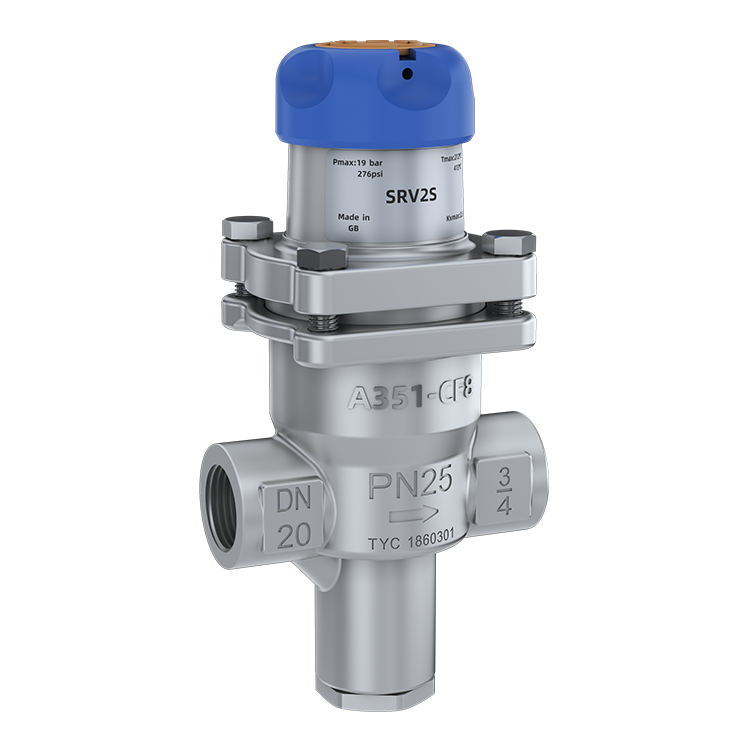
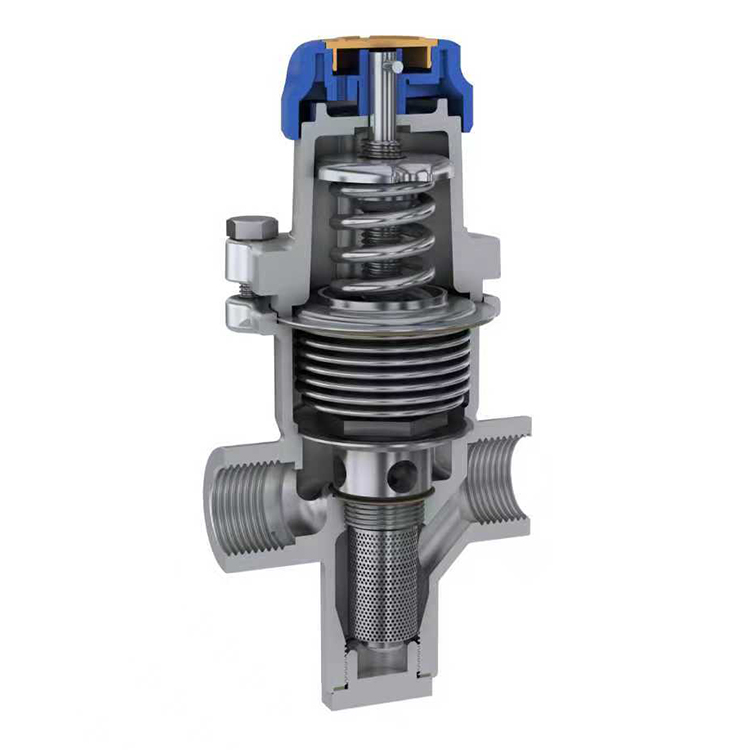
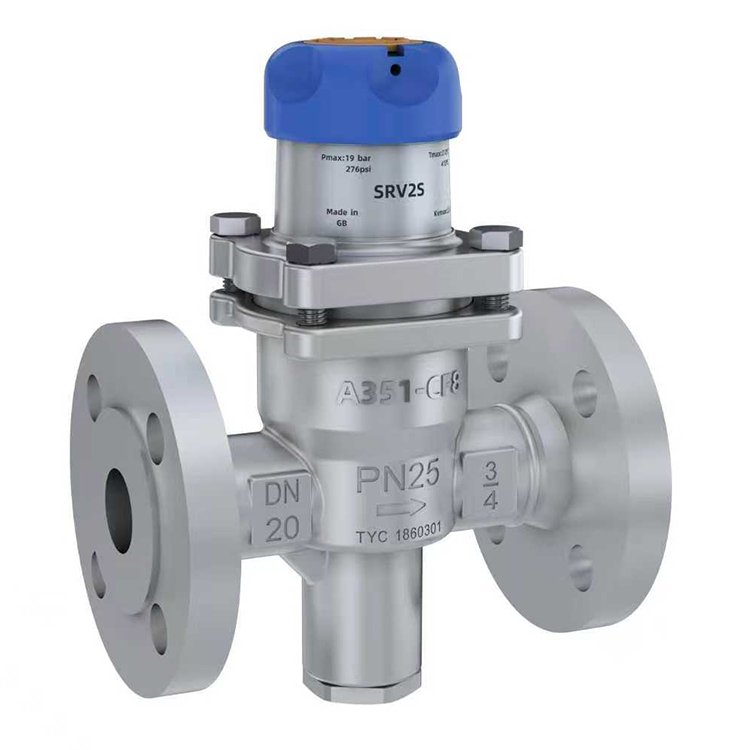
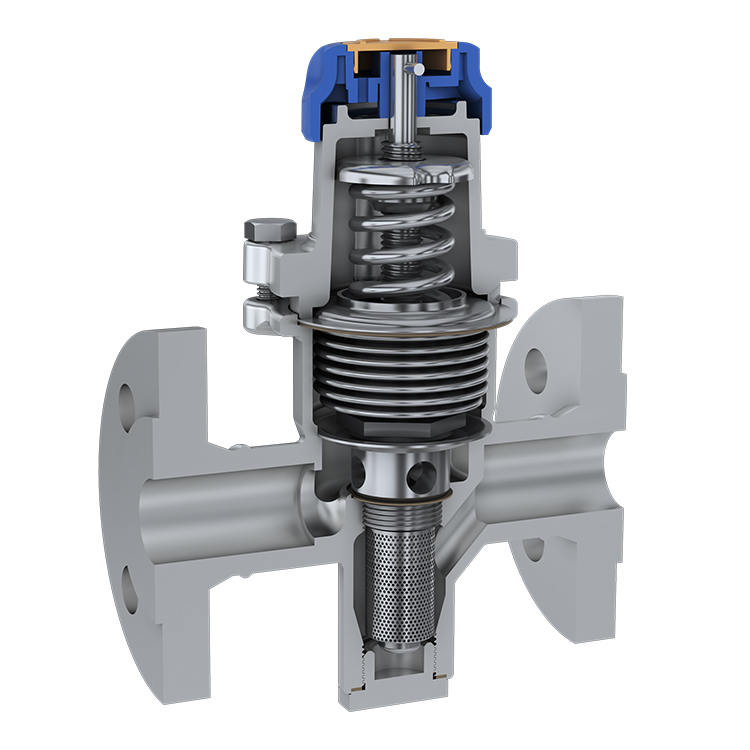
The SRV2S stainless steel direct-acting pressure reducing valve is compact and suitable for steam or gas systems such as compressed air. All parts in contact with the medium are made of stainless steel.
| Limitations (Stainless Steel) | ● Design pressure (PMA): 25 bar ● Maximum operating pressure (PMO): 19 bar ● Maximum operating temperature (TMO): 212℃ |
| Installation Instructions | Please install the pressure reducing valve on a horizontal pipe following the direction of the arrow on the valve body. |
| Bill of Materials | ● Valve body and cover: CF8, CF3M ● Valve seat: F304, F316L ● Valve core: SUS440C ● Bellows: 316Ti ● Pressure regulating spring: Silicon-chromium spring steel |
| Downstream pressure range | There are three different downstream pressure setting ranges, distinguished by color on the handwheel’s color indicator: ● Gray downstream pressure range: 0.14 bar – 1.7 bar ● Green downstream pressure range: 1.4 bar – 4.0 bar ● Orange downstream pressure range: 3.5 bar – 8.6 bar |

Dimensions/weight (approximately) mm and kg
| model | SRV25 | |||
| Nominal diameter | 15 | 20 | 25 | |
| A(mm) | 83 | 96 | 108 | |
| B(mm)ANSI 150 | 140 | 153 | ||
| B(mm)Pn25 | 150 | 160 | ||
| C(mm) | 62 | |||
| D(mm) | 130 | |||
| E(mm) | 25 | |||
| Weight (Kg) | Thread | 1.6 | 1.7 | 1.8 |
| flange | 3.2 | 4 | 4.5 | |
Displacement is used for safety valve selection.
Full-open flow rate is used for safety valve selection.
| Caliber | DN15 | DN20 | DN25 |
| Cv | 1.5 | 2.5 | 3 |
Conversion formulas: Cv(UK) = Kv x 0.963 Cv(US) = Kv x 1.156
Saturated steam and compressed air selection

How to use the selection chart
The curves labeled 2, 3, 4, 5, etc. represent upstream pressure, and the vertical line on the left side of the figure represents downstream pressure.
Example description
The pressure reducing valve requires a flow rate of 120 kg/h, with the pressure decreasing from 8 barg to 6 barg. Moving horizontally to the right along the downstream pressure (6 barg) curve shown on the left side of the diagram, until it intersects with the upstream pressure (8 barg) curve, and then vertically downwards along the intersection point, it can be seen that SRV2S meets the requirements.
Troubleshooting
Before troubleshooting, ensure that both upstream and downstream isolation valves are closed and that the SRV2S is depressurized.
| Symptom | Downstream pressure is higher than the set pressure |
| Reason 1 | Bellows failure or leakage |
| Inspection and solutions | Replace the bellows assembly and check that the valve failure is not due to bellows fatigue caused by frequent pressure fluctuations. |
| Reason 2 | Valve seat corrosion or damage |
| Inspection and solutions | Replace valve core and valve seat assembly |
| Reason 3 | Excessive debris/scale buildup on the valve seat and valve core clogs the pressure sensing orifice/adheses the push rod. |
| Inspection and solutions | Replace valve core and valve seat assembly |
| Symptom | Under full load conditions, the downstream pressure is lower than the set pressure. |
| Reason 4 | Valve set under no-load conditions |
| Inspection and solutions | Reset under full load (see Section 3 Start-up and Adjustment). |
| Reason 5 | The valve is too small for the required load. |
| Inspection and solutions | Check the maximum operating load and the selected valve diameter and install. |
| Symptom | The adjustment handwheel cannot be turned |
| Reason 6 | Positioning pin prevents adjustment |
| Inspection and solutions | Remove the locating pin from the valve cap. |
| Symptom | Fluctuation/Control Instability |
| Reason 7 | wet steam |
| Inspection and solutions | Ensure that steam traps are installed correctly on the pipelines, and install steam separators if necessary. |
| Reason 8 | External signal interference |
| Inspection and solutions | Check the nearest valve to its corresponding control device, such as an on/off valve. |
| Reason 9 | The push rod is stuck together due to the accumulation of dust/scale. |
| Inspection and solutions | Replace valve core and valve seat assembly |


