What is a pressure reducing valve?
A pressure reducing valve is a regulating valve that counteracts load variations, keeping the pressure of the secondary fluid, which is lower than the primary pressure, stable at a certain level.
1. Direct-acting formula
The secondary pressure sensing component directly drives the valve opening and closing action. Suitable for small flow control, compact and lightweight.
Main uses
●Food processing machinery
●Washing equipment
●Low-pressure air equipment
●Steam sterilization equipment, etc.
Simple in construction, suitable for small flow control
2. Pilot type
A direct-acting component that detects secondary side pressure acts as a pilot valve. By adjusting the pressure in the main valve’s operating section, the main valve’s opening and closing action is controlled. This ensures high flow rate and stable control.
1) Diaphragm type
The main valve operating section uses a large diaphragm. With a large Cv value, the secondary pressure variation caused by a flow rate change from the minimum regulated flow rate to the rated flow rate is minimal, giving it performance similar to a control valve.
Main uses
●Air conditioning equipment
●Building equipment
●Factory equipment, etc.
Using a diaphragm with a large pressure-bearing area improves the main valve’s on/off capability, achieving high flow rates and superior flow characteristics.
2) Piston type
A piston cylinder is used as the main valve operating unit. It is mainly used in steam systems, and the secondary side pressure can be stably controlled with a fluctuation range within 0.05MPa (*).
Main uses
●Air conditioning equipment
●Building equipment
●Factory equipment
●Farmland irrigation
Using a piston cylinder as a pressure-bearing element improves the main valve’s switching capability, making it suitable for a wide range of applications from small to large flow rates, and offering superior durability.
Pressure detection methods and control
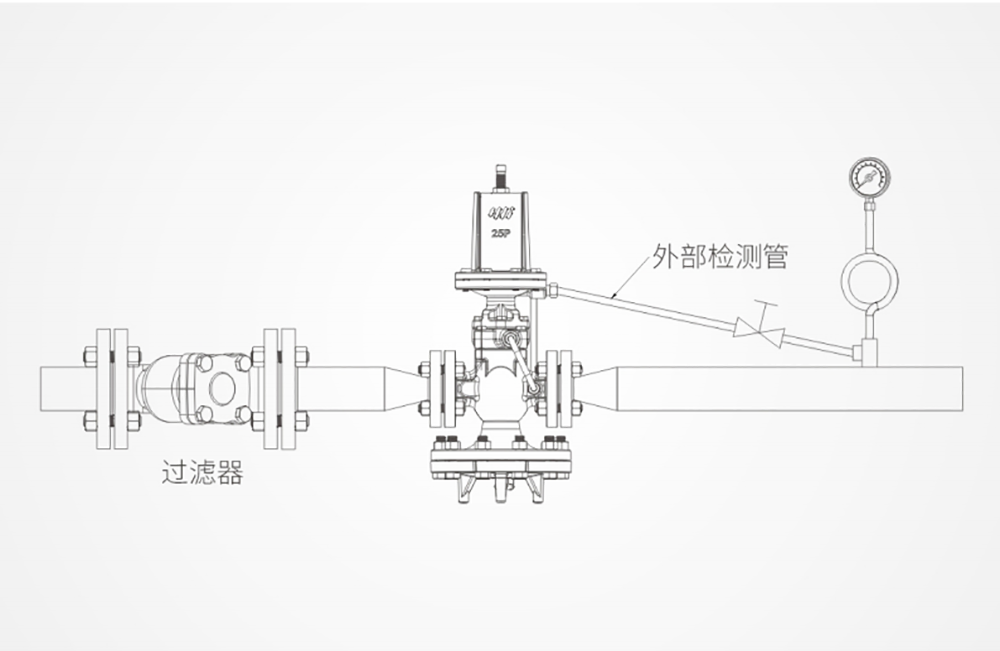
External detection
The 25P series pressure reducing valves use external sensing as a standard, ensuring stable operation even under conditions of drastic flow fluctuations. By sensing pressure from the source where the desired pressure is to be controlled, pressure stability in steam-using equipment can be significantly improved.
Pressure detection methods and control
Steam is a compressible fluid; the lower the pressure, the larger the volume per unit mass. Therefore, when operating at low secondary pressure, pressure loss occurs as the steam flow rate increases, leading to a pressure drop. External monitoring can resolve this issue.